
March 18, 2026
From One-Third Vacant to Two Percent: A Workforce Development Masterclass in Regional Australia
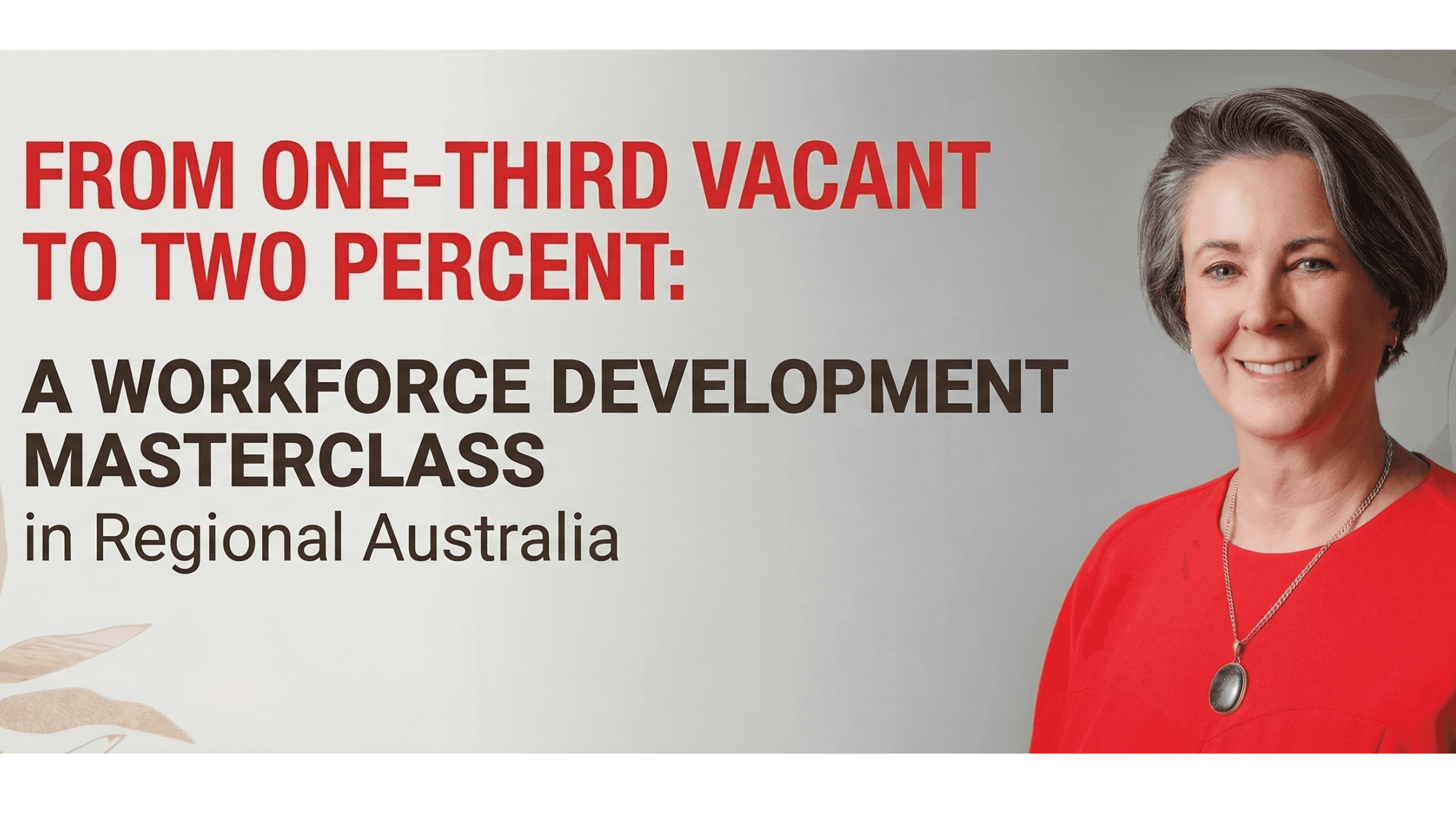
Every organisation talks about investing in people. Karina Ewer actually did it — and the results speak for themselves.
Regional Australia has a workforce problem. Skills shortages, thin talent pools, limited housing, and the gravitational pull of metropolitan salaries make attracting and retaining capable people one of the most persistent challenges facing regional employers. Local government sits at the pointy end — delivering essential services with lean teams across vast geographies, often without the budget flexibility of the private sector.
Karina Ewer knows this reality intimately. When she took the reins at Berrigan Shire Council in 2021, twenty percent of budgeted positions were vacant. By the time she departed four years later, vacancy rates sat at just two percent — and have remained there since. No recruitment agency magic. No inflated salary packages. Instead, a deliberate, people-centred approach to workforce design that offers a practical blueprint for any organisation struggling to attract and retain talent.
Now CEO of Charters Towers Regional Council in North Queensland — a region spanning more than 68,000 square kilometres — Karina sat down with MCBI to unpack the workforce strategies that made the difference.
A Workforce Development Lens, Shaped By Experience
Karina’s approach to workforce development has been shaped by a career that spans sectors. Starting as an executive assistant, she moved through project management and natural resource asset management before landing at the Queensland Ambulance Service. It was at QAS where her instinct for building capability became clear: she grew a small, registered training organisation from basic first aid delivery into a substantial, sustainable operation — strong relationships with industry, quality facilitators, real paramedics in the room, and professional products that earned credibility with mining companies and emergency response teams.
“If you asked me even ten years ago if I’d ever be CEO of a council, I’d have looked at you like you had another head. The opportunities have come up, and I’ve always sort of thought — what’s the worst they can say?”
From QAS she moved to Streaky Bay on South Australia’s west coast, stepping up from corporate services manager to CEO. She’s grateful for cutting her teeth in a small council where she was still doing the doing — a hands-on apprenticeship that gave her a deep understanding of how services are actually delivered. In remote communities, she learned, people are extraordinarily self-sufficient and everyone wears multiple hats. These insights proved foundational to her workforce thinking at Berrigan and beyond.
Diagnosing A Workforce In Crisis
Berrigan is a small town in the southern Riverina of NSW, close to the Victorian border. Karina arrived in the heart of COVID — lockdowns, border permits required just to buy groceries or see a doctor, and the constant tension between respecting people’s rights and enforcing legislated rules.
But the deeper issue was structural. One in five positions sat empty. Rubbish still needed collecting. Water treatment plants still needed running. Some constraints were fixed — the distance from a metro centre, limited housing. Karina couldn’t change those. So she turned her attention to what she could: how work was designed, how people were paid, and how the organisation treated its workforce.
Redesigning Work: The Three Levers
1. Pay Equity and Workforce Harmonisation. Karina mapped the entire workforce and harmonised wages across indoor and outdoor roles. A Cert IV in business administration and a Cert IV in outdoor maintenance? Same qualification level, same pay. The gap between white-collar and blue-collar remuneration for equivalent skill levels was entrenched. Fair pay, paid on time — she considers it the non-negotiable foundation of any workforce strategy.
2. Flexible Work Design — For Everyone. Flexibility wasn’t reserved for the office. Start and finish times were opened up across the whole organisation. Some professional roles were filled by people based in Melbourne, working fully remote with one day a month on-site. Mothers returning from maternity leave came back on as little as one day a week. Job-sharing became standard.
“We couldn’t compete with corporates on wages, so we had to get creative with what jobs look like. But you absolutely have to ensure expectations and reporting are clear.”
When outdoor crews initially pushed back, Karina addressed it directly. They received their own flexibility: staggered hours to manage extreme heat and a fundamental rethink of rosters. Her water and sewer team had been grinding through unsustainable overtime, with sick leave climbing as a result. A frank conversation led to a six-days-on, four-days-off roster across two teams to cover seven-day requirements. Overtime dropped. Sick leave dropped. It just needed someone to step away from historical ways of working.
3. A Family-First Workforce Culture. Karina is a fierce advocate for putting family first. Children are only young once, she says. When the local daycare centre closed on Fridays and several staff feared they’d have to resign, she stood up a crèche at the council. She facilitated before and after school care so parents could work longer hours. Productivity was maintained. People stayed. In a tight labour market, retention is workforce development — and removing barriers to participation is one of the most powerful levers a leader can pull.
Better Conditions, Better Workforce
The results went beyond filling vacancies. When Karina started at Berrigan, the workforce was predominantly male. When she left, the gender split was roughly fifty-fifty, with a notably higher level of multicultural employees as well. She enlisted the male workers to help drive the change — making it a collective effort, not a top-down directive. Her thesis is straightforward: when you design better conditions for everyone, workforce composition shifts as a natural consequence.
The Human Cost Of Getting It Wrong
Karina’s commitment to treating people with care was forged in one of the hardest moments of her career. When then-Queensland Premier Campbell Newman mandated the reduction of 10,000 public service roles across the state, she was told to let people go that same day. No lead time. No empathy.
“You could have reached the same conclusion but treated the humans with integrity. These are real people with lives and responsibilities.”
It became a defining conviction: however hard the decision, the way you treat people in the process matters as much as the outcome. For anyone in workforce development, it’s a reminder that how we manage transitions — restructures, redundancies, role changes — is as much a part of our capability as how we recruit and develop.
Building Capability: ‘Hard’ Skills And Pipeline Investment
Karina is a lifelong learner — currently completing her PhD, lecturing at James Cook University, and guided by a family motto: education is no burden to carry. She believes it is the responsibility of leaders to continue their own development — learning to work with people, to stay calm, to not react.
She’s passionate about what she calls ‘hard’ skills — her pointed riff on the misnomer of ‘soft’ skills. People skills. Leadership. Communication. Emotional intelligence. The hardest capabilities to develop and the most essential to get right. She agrees that technically proficient people promoted off the tools into leadership need structured support to build a completely different skillset. Without it, organisations lose good operators and gain struggling managers.
“If you don’t invest, you can’t deliver. It’s that simple.”
At Charters Towers, she’s implementing a capability framework and investing in emerging leaders ahead of time — building the pipeline proactively, not waiting until the gap is urgent. Despite tight budgets, she prioritises professional development because she understands the cost of not doing so. Underinvestment in people capability doesn’t save money. It creates turnover, performance gaps, and service delivery risk.
Looking Forward
Karina acknowledges the rising role of technology and AI in local government, stressing the need for strong governance and clear policies. But she cautions against cutting roles in favour of automation. Executive assistants, she says, run the checks and balances — they’re the right hand of an executive. Undervalued and extremely important. If you have a good EA, hold on to them forever.
When asked if she considers herself a role model, the answer is characteristically understated.
“I’m just me. You can’t be what you can’t see, and there are still not many women in leadership roles in local government. If my career is useful to see, that’s flattering. Fairness is hugely important to me.”
For MCBI, Karina’s story is a reminder that workforce development isn’t always about training programs and qualifications — though those matter. Sometimes the most transformative workforce strategy is redesigning the conditions of work itself: paying people fairly, giving them flexibility, investing in their growth, and treating them like the adults they are. In regional Australia, where the margin for error is thinnest, getting this right is the difference between a workforce that stays and one that walks.
MCBI Insights spotlights leaders and practitioners shaping workforce development across Australia. If you know someone whose story deserves to be told, or if Karina’s approach resonates with your organisation, get in touch.
Latest news



Ready to unlock
what's possible?
18 years of experience. Proven results. A team that's genuinely invested in your success.

