
April 16, 2026
Farming the Light: Knowledge, People and Innovation in a Third-Generation Orchard
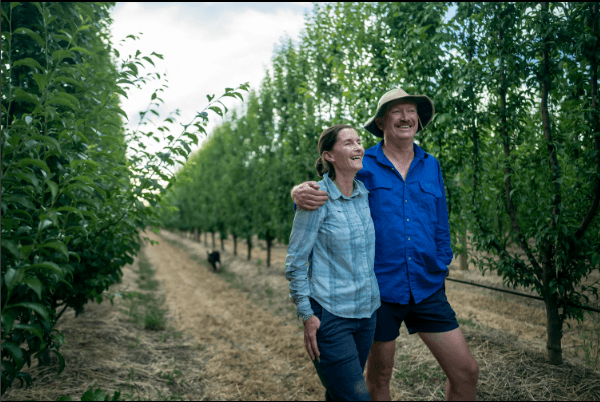
A conversation with Andrew Routley, Booma Fresh & Little Tree Company, Katunga, Victoria
There is a phrase Andrew Routley uses to describe what he does that stops you mid-sentence. 'We're light farmers,' he says. 'We're farming the sun's light.' He means it precisely - every decision about how a tree is structured, how a canopy is managed, how rows are oriented is about maximising light interception to grow the best possible fruit. It is an elegant framing for an operation that is, in practice, extraordinarily complex.
Andrew is the third generation of the Routley family to work the land at Katunga in Victoria's Goulburn Valley. His grandfather planted the first trees. His father built on it. Andrew and his wife Claire have evolved it into something his grandfather couldn't have imagined: an internationally connected, innovation-driven operation spanning premium stonefruit growing, applied variety research, and nursery development for new genetics entering the Australian market. Their children - potentially the fourth generation - are still young. The decisions being made now will determine whether they have something worth coming home to.
The Accidental Farmer
Andrew didn't plan to take over the orchard. He grew up working it - driving a forklift in the packing shed at eight years old - but never saw it as a career path. When university offers came, he didn't take them up. 'Nobody else I knew was going to university. Most of my peers went into apprenticeships or stayed on their family farm. I was too scared to head to the big city.'
What changed things was a student exchange program through the University of Melbourne that took him to the United States. His father wasn't impressed at the time. Andrew went anyway - and it planted something that has become central to how he runs his business: the understanding that you cannot stay current by staying home.
Building the Next Generation — Before They're Ready
Andrew and Claire's succession approach isn't to preserve what exists for their children to inherit - it's to expand the operation so that if they come back, each steps into a genuinely distinct area of management. 'As the business scales up, the children can have their own area so they're not crossing paths.'
The expectation is that they won't return straight from school - first a degree, work elsewhere, find their place in life. International internship opportunities are already on the horizon, and the children have been travelling with Andrew and Claire since they were small. 'It's about who you know,' he says. 'Relationships are everything.'
"As the business scales up, the children can have their own area. So they're not crossing paths."
Workforce Planning: The McDonald's Principle
Seasonal horticultural labour is one of Australia's most structurally complex workforce problems - and Andrew is candid about where the system is breaking down. Formal agricultural qualifications have largely disappeared. TAFE used to offer horticulture apprenticeships; low demand saw those programs wind back.
The PALM scheme brings Pacific Islander workers for up to nine months, but the structure limits investment in their development. 'If they came for longer, you could justify more investment in their skills rather than the current nine-month program.' His workforce mix is roughly 60% Pacific Islander, 30% South-East Asian, and 10% working holiday makers.
His approach to managing this is twofold: build a core of returning workers year on year, and design the operation so less depends on individual skill. He applies what he calls the McDonald's principle - deliberately prescriptive and consistent. 'We've dumbed it right down. We don't want them to have to think too much.'
Being an employer of choice is equally deliberate: pay more, pay piece rates, keep the orchard clean, treat people with respect. Monthly staff barbecues, an employee of the month program, A manager brought in specifically because of her skills and belief that care and people management are as important as any operational skill. 'I try to get around and see everyone every day. Small things that count.'
"There's a perception that 'fruit picker' is simple work. People don't see everything that goes behind it."
Looking ahead, Andrew sees technology as the most significant shift coming for workforce capability in horticulture. 'It's all about tech, where it's going to go – it’s very exciting. Workers are going to need to be tech-savvy.' The skills required on a modern orchard are already a long way from the industry's public perception.
Technology: Targeted, Not Wholesale
LiDAR-equipped sprayers scan each tree, build a 3D picture of the canopy, and target application accordingly - reducing chemical use by 40%. The same technology maps blocks by fruit density. Irrigation is monitored and automated.
While technological advancements are exciting, he's learned to resist his instinct to move fast. 'I have a bad habit of going all in. There are so many variables - you change things and you can't tell if it was A, B, or C.' New technologies are now trialled over several seasons before full adoption.
Going Global to Stay Relevant
Andrew visits breeding programs in California and Spain that he has long relationships with - and in some cases holds rights to. The reason for being there in person is specific: he needs to physically see and taste. Importing material through Australian quarantine costs around $25,000 per variety. 'You can't take a shotgun approach. The variety must be a winner before it comes to Australia.' Overseas breeders may produce 100,000 varieties in a program; the strike rate from breeding to commercial variety is roughly one in 15,000, with a ten-year lead time to market.
His Little Tree Company is the Australian nursery partner for a program with Freshmax and Spanish breeder Provedo - importing, testing, and commercialising new stonefruit varieties locally. He works with Montague and Freshmax to develop programs around promising varieties, focusing on extending the season window and replacing weaker lines.
The evaluation is rigorous: 'Is it unique? What's the expected sale price? Where does it fit? Do the marketers want it?' The industry's holy grails - cherry plums and seedless plums - remain ten to fifteen years away. The consumer thesis driving all of it: people are eating less, portions are smaller, and volume is no longer the answer. 'Better genetics, better husbandry, harvested at optimum maturity. A win for us, a win for the retailer, a win for the consumer.'
Croc Eggs: Controlling the Supply Chain
About fifteen years ago, Andrew was in California tasting fruit when he tried a plum variety that stopped him. He bought the license to propagate it, approached Montague, and the Croc Eggs branded range was born - now one of the most recognised premium stonefruit brands on Australian supermarket shelves, with the Routleys by far the largest growers in the program.
From first planting to first sale was three years. The bet required believing in the product and in Montague as a marketing partner. 'When you jump in bed with a marketing company, it's a big bet. It’s exclusive. You’re stuck with them.' Claire was the conviction behind the punt. 'She's decisive and bold like that. Willing to put a punt on.' Their dynamic is telling: Andrew is the artist, always ready to try something new. Claire is the CFO, the operational anchor, and 'arguably the bigger half - with the drive and the preparedness to follow dreams.'
"She's decisive and bold like that. Willing to put a punt on. Claire is arguably the bigger half."
The strategy extends beyond Croc Eggs. Andrew studies supermarket produce sections the way others study markets - watching how shelf space is claimed, how categories expand. 'Back in the day there were two tomato varieties. Now there are around thirty.'
Colour Cots - an apricot-plum cross with exotic flavour – with the first trees already in the ground and two new varieties under assessment this season. The goal is a branded season running eighteen to twenty-four weeks. 'If you have a branded product, you have to control the standard.' From rootstock to retail, the Routleys control their own destiny on the varieties they back.
The Regional Ecosystem and the Corporate Capital Question
The Goulburn Valley is changing. Family orchards have declined dramatically; more fruit is grown than ever, but increasingly by corporate entities. Corporates don't trial new varieties - they plant the proven ones. The innovation pipeline that creates new premium categories comes from family growers willing to back something unproven. That pipeline is narrowing. Chile compounds the pressure - a major horticultural competitor that can do everything cheaper, with big US corporate players already in market. The response isn't to compete on cost. It's to keep being premium, unique, and exclusive.
Canadian pension funds hold billions in Australian agricultural assets, with a direct effect on land prices. 'The influx of corporate activity has pushed land prices beyond sustainable return.'
But the relationship with corporate partners isn't simply adversarial - equity is critical, and the model can work. 'Trust is essential on both sides.' The problem is management quality in large organisations. 'For so many people in big corporates, it's just a job.' Andrew's view is direct: the best way for a corporate to build a quality operation in regional horticulture is to buy a farm and buy the farming family with it.
"The best way to build a quality operation is to buy a farm and buy the family with it."
What institutional capital consistently underestimates is that the value of a family operation is not reducible to its balance sheet. The knowledge, the relationships, the willingness to back something unproven for a decade - these are what drive returns. They don't show up in a KPI.
Ten Years From Now
One or more of the children home and working. A third commodity to diversify. The Croc Eggs program expanded domestically and into export — China showing good traction, Vietnam emerging. And a market that is shifting in their favour: people eating less, paying more for premium. 'The change in diet is massive. We just must get better at delivering the product and getting more consumer awareness.'
The bet Andrew and Claire are making is a simple one: that consumers will keep paying more for fruit that's genuinely worth it. In an industry being reshaped by corporate capital and competitive pressure from every direction, backing premium, backing exclusivity, and backing the next generation to come home - that might be the most radical ambition of all.
Latest news




Ready to unlock
what's possible?
18 years of experience. Proven results. A team that's genuinely invested in your success.

